
Where AI Belongs in Your Sales Operation
Most small and medium-sized businesses meet AI as a tool in their sales operation: a chatbot on the website, a writing assistant, an app that promises to do the admin. The more useful question is a different one. Where, in the path from first enquiry to paid job, should AI sit, and where should it not?
This post is for owners of UK small and medium-sized businesses who are curious about AI but wary of handing customers to a machine. By the end you will have a way to mark each step of your own process as something AI can draft, something a rule can handle, or something a person must decide. I am not going to review tools. Tools change every month. The structure does not.
Start with the path, not the tool
On our home page we describe the slow version of a small or medium-sized business operation: a customer finds you, fills in a generic form, and the enquiry sits unanswered while you are busy working. Then you chase them to find a time. Write your own version of that path on one page:
- enquiry arrives
- first reply
- qualifying questions
- booking
- quote or proposal
- follow-up
- delivery
- invoice
- review request
For each step, ask three questions. Is it the same every time? Does it involve a judgement? What happens if it goes wrong?
What rules handle better than AI
A surprising number of steps need no AI at all. An instant acknowledgement, an alert to your phone, a booking calendar, a reminder the day before: these are rule-based. They do the same thing every time, which is exactly what you want. Setting them up first gives you most of the speed benefit with none of the unpredictability.
What AI is good for
Where wording or sorting is involved, AI can save real time. In my view, the sensible jobs are:
- Drafting. A first version of a reply, a follow-up, or a summary of a call.
- Sorting. Reading a free-text enquiry and tagging it by service, location and urgency.
- Preparing. Turning a form submission into a three-line brief before a call, so you walk in informed.
Notice the pattern. In each case, AI produces something that a person reads before it matters.
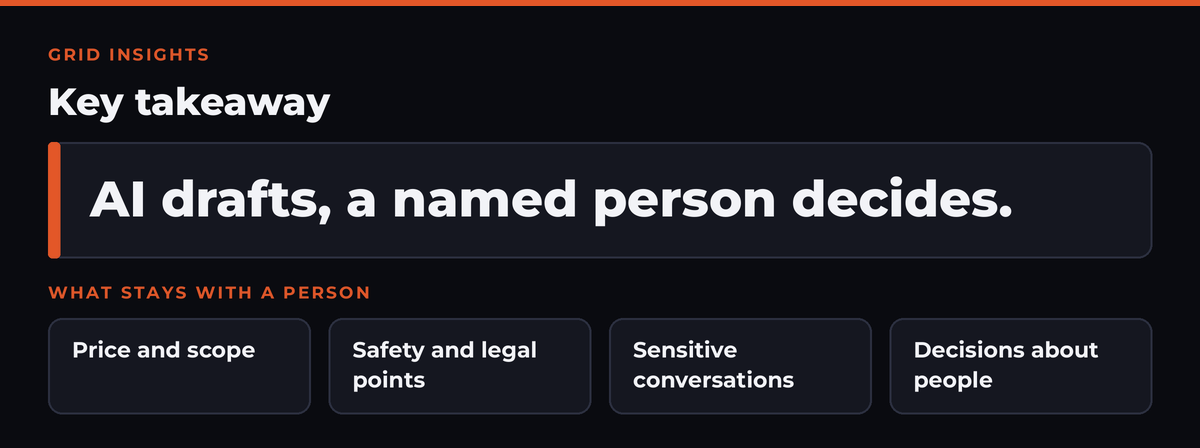
What a person must decide
Keep these with a person:
- Price and scope. What you charge and what is included.
- Safety and legal points. Anything where a wrong answer could cause harm.
- Sensitive conversations. Complaints, bereavements, money worries.
- Decisions about people. Whether someone gets your service, a refund or a discount.
The last point has a legal side. Under UK GDPR, Article 22 gives people extra protection when a decision with legal or similarly significant effects is made solely by automated means. The ICO's AI guidance explains that mere human involvement does not automatically count as meaningful review, and that the human must be able to change the outcome. The Data (Use and Access) Act 2025 has changed parts of this regime. The ICO says all of the Act's data protection provisions are now in force, and has consulted on new draft guidance on automated decision-making, with a statutory code of practice on AI and automated decision-making expected. A law firm summary of that consultation stresses that human involvement must be active, not a token gesture, and should be recorded.
For most UK service businesses the practical rule is simple: AI drafts, a named person decides.
Be open about it
The ICO's checklist for small organisations expects you to tell people how you use their data: who is responsible, what you do with it, who you share it with, how long you keep it, and how they can use their rights, in language that is easy to understand. If an AI tool processes enquiries, check where the supplier sends the data and what its terms say, and reflect that in your privacy notice. The ICO notes that its guidance is under review following the Data (Use and Access) Act, so check the current version.
I would also be cautious about pasting customers' personal or health details into a general-purpose chatbot. Know where the data goes before you do it.
An illustrative example
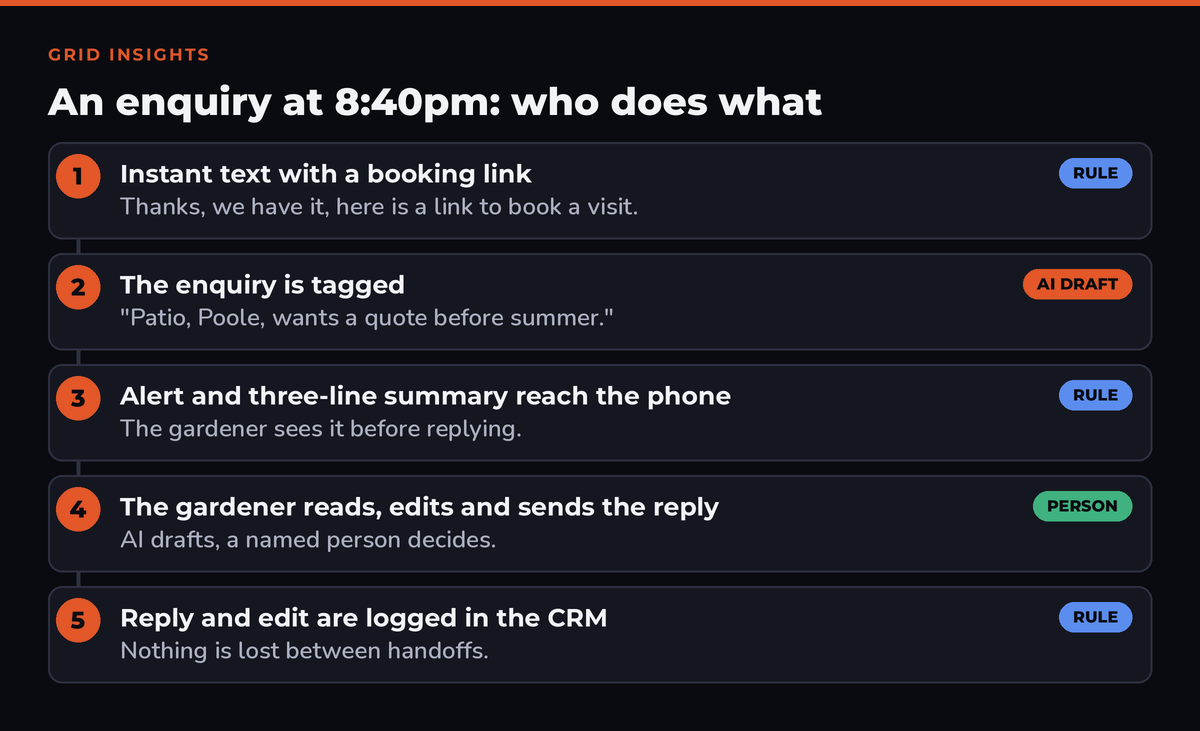
Picture a gardener who gets an enquiry at 8:40pm.
- A rule sends an instant text: thanks, we have it, here is a link to book a visit.
- The enquiry form is tagged by AI as "patio, Poole, wants a quote before summer".
- An alert and a three-line summary reach the gardener's phone.
- In the morning, the gardener reads the summary, edits the AI's draft reply and sends it.
- The reply and the edit are logged in the CRM.
At no point does the AI quote a price or promise a date. Everything that matters is in a person's hands.
A process to set it up
- Map the path on one page, as above.
- Automate the rule-based steps first. Acknowledgement, alerts, calendar, reminders.
- Add AI only where wording or sorting is needed.
- Put a human between AI and the customer for anything non-routine.
- Log what the AI suggested and what the person did.
- Review weekly. What did it get wrong? What did it miss? Adjust.
Checklist
- I have written my enquiry-to-review path on one page.
- Every step is marked as rule, AI draft or person.
- Instant acknowledgement, alerts and reminders are set up before any AI.
- A named person approves anything AI drafts for a customer, apart from routine acknowledgements.
- AI never decides price, scope, safety or eligibility.
- My privacy notice mentions how I use customer data and any AI tools.
- I know where my AI supplier sends and stores data.
- I review mistakes every week.
Where GRID fits
The GRID services page lists smart automations, CRM pipelines and booking systems as core builds. The approach above is how I would structure them: rules first, AI where it helps, and a person where it matters.
Frequently asked questions
Do I need to tell customers I use AI?
The ICO expects you to be open about how you use personal data, and to explain it clearly. If AI tools process customer information, say so in your privacy notice. Take advice if you are unsure.
Can AI reply to enquiries by itself?
For routine acknowledgements and booking links, yes in practice. For anything that affects price, eligibility, safety or a complaint, I would keep a person in the loop.
Will AI replace the person who answers my phone?
That is not the question I would start with. Start with where enquiries are being lost, and fix that. AI is one possible tool, not the plan.
End of article
Sources
- ICO, Are you transparent about how you use people's data?, accessed 26 November 2026.
- ICO, What is the impact of Article 22 of the UK GDPR on fairness?, accessed 26 November 2026.
- ICO, The Data (Use and Access) Act 2025: what does it mean for organisations? (updated 19 June 2026), accessed 26 November 2026.
- Burges Salmon, Automated decision-making: ICO consults on new guidance following DUAA reforms (6 May 2026), accessed 26 November 2026.
- GRID Marketing, Home and Services, accessed 26 November 2026.
Next step
You can also contact us if you would rather send a message.