
Speed to Lead: Why the First Hour Matters for Enquiries
It is 4:12pm on a Tuesday. A new enquiry arrives while you are up a ladder, on a client's driveway, or with your hands full in a session. You see it at 7pm, reply at 7:20, and get nothing back. By then, they have spoken to someone else.
This is the most common way a small or medium-sized business loses work, and it rarely feels like losing. Nothing goes wrong. The enquiry just goes cold. That delay is a speed to lead problem: the time between the enquiry and your first real reply. This post is for owners of UK small and medium-sized service businesses who get enquiries by form, message or phone call and want a simple process for the first hour. It also explains what the research says and, just as important, what it does not say.
What the research says
The best-known study is "The Short Life of Online Sales Leads" by James Oldroyd, Kristina McElheran and David Elkington, published in Harvard Business Review in March 2011. It had two parts.
In the first, the authors sent a web enquiry to 2,241 US companies and timed the replies. 37% responded within an hour and 16% within one to 24 hours. 24% took more than 24 hours, and 23% never responded at all. Among those who replied within 30 days, the average response time was 42 hours.
In the second, they analysed 1.25 million sales leads handled by 29 consumer-facing and 13 business-to-business US companies. Firms that tried to contact a lead within an hour were nearly seven times as likely to qualify it (meaning a meaningful conversation with a key decision maker) as firms that tried even an hour later, and more than 60 times as likely as firms that waited 24 hours or longer.
What it does not say
I want to be straightforward about the limits, because this study is often quoted as if it were a law of nature.
- It is American, and old. The data was collected before 2011 and covers US companies, not UK small or medium-sized service businesses.
- It shows a link, not a cause. Firms that reply quickly may also be better run in other ways.
- It measures conversations, not sales. Qualifying a lead is not the same as winning the job.
- One author led a lead-response software company. David Elkington was chairman and CEO of InsideSales.com at the time, which is worth knowing when weighing the conclusions.
You will also see a "five minute rule" quoted widely. One review of the research notes that it comes from a vendor study that did not measure sales. I do not use it as a target for that reason.
So the honest reading is this: the evidence points firmly in one direction, which is that slow replies cost you conversations, but I cannot promise that any particular response time will win you any particular number of jobs.
Where small and medium-sized businesses leak enquiries
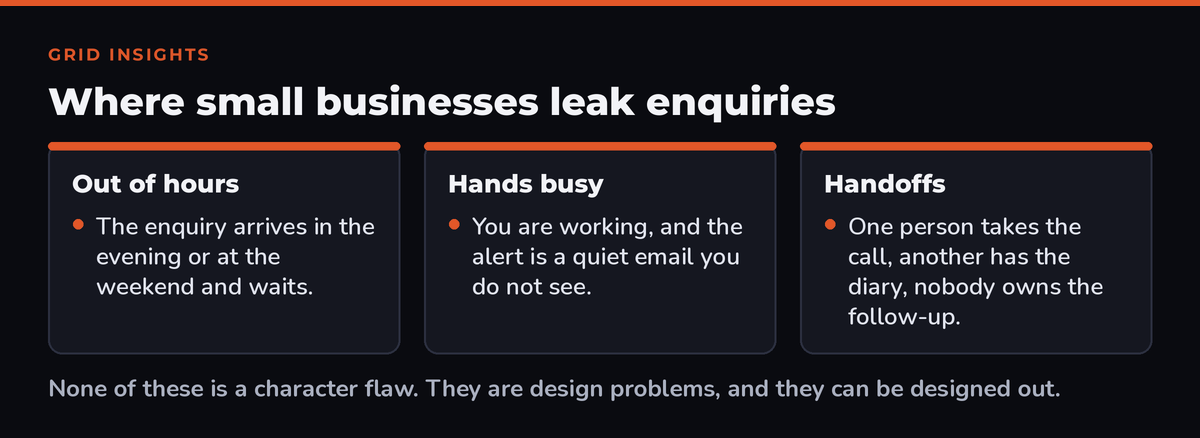
When I map how enquiries move through a small or medium-sized business, the same three leaks keep appearing:
- Out of hours. The enquiry arrives in the evening or at the weekend and waits.
- Hands busy. You are working, and the alert is a quiet email you do not see.
- Handoffs. One person takes the call, another has the diary, nobody owns the follow-up.
None of these is a character flaw. They are design problems, and they can be designed out.
A first-hour process you can build
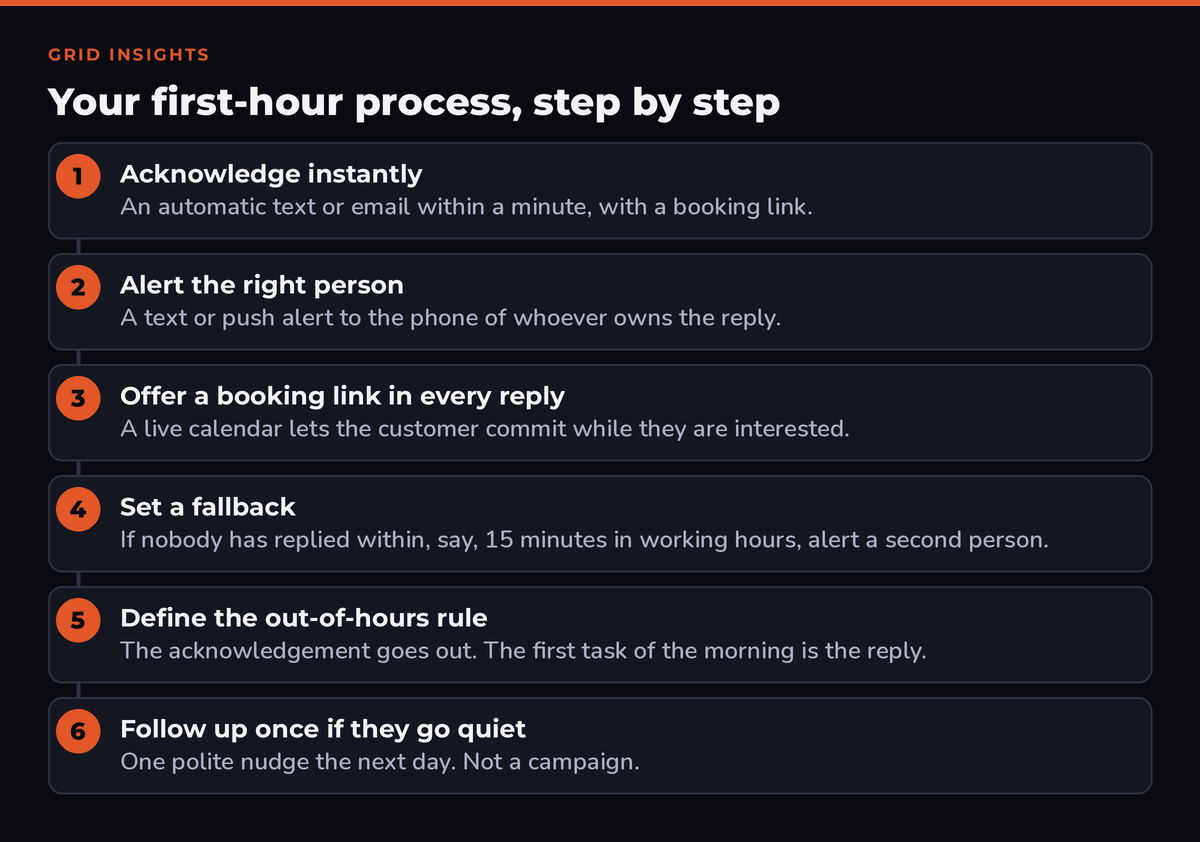
- Acknowledge instantly. An automatic text or email within a minute: "Thanks, we have your enquiry and will be in touch shortly. If you would like to book a time now, here is the link." It confirms they reached you and gives them something to do.
- Alert the right person on their phone. Not a message buried in an inbox. A text or push alert to whoever owns the reply.
- Offer a booking link in every reply. A live calendar lets the customer commit while they are interested.
- Set a fallback. If nobody has replied within, say, 15 minutes during working hours, the alert goes to a second person or repeats.
- Define the out-of-hours rule. Decide what happens to an enquiry at 9pm and write it down. The acknowledgement goes out, and the first task of the morning is the reply.
- Follow up once if they go quiet. One polite nudge the next day. Not a campaign.
An automatic acknowledgement is a service message, not direct marketing, as the ICO describes it. Keep it to confirming the enquiry and next steps. If you add a promotion, it becomes marketing and needs the right consent.
What to measure
You do not need an analytics team. Record three numbers each month from your own enquiries:
- Time to first reply. The median, not the best case.
- Enquiry to booking. How many enquiries became a booked call or visit.
- Missed enquiries. How many got no reply at all within a day.
Do not compare these with anyone else's figures. Compare them with your own last month.
Checklist: first hour
- Every enquiry gets an automatic acknowledgement within a minute.
- An alert reaches a named person's phone.
- Every reply includes a booking link.
- A fallback exists if the first person does not reply.
- The out-of-hours rule is written down.
- One follow-up goes out if the customer goes quiet.
- Acknowledgements contain no promotional content.
- Time to first reply and enquiry-to-booking are recorded monthly.
Where GRID fits
This is a good example of work that automation does better than willpower. On the GRID services page you will find instant lead alerts, booking engines and reminder workflows listed as part of the builds. The point of them is the process above: reply fast, book early, follow up once.
Frequently asked questions
How fast should I reply to a new enquiry?
The research suggests faster is better, and I would aim for minutes during working hours, with an instant automatic acknowledgement at any time. I cannot give you a number that guarantees a result.
Is an automatic text reply allowed?
An automatic message that confirms an enquiry or booking is a service message under the ICO's description, not direct marketing. Adding promotional content turns it into marketing, which needs the right consent.
What if I cannot reply quickly because I am on a job?
That is the case for an automatic acknowledgement and a booking link. The customer gets a response and a way to move forward while you work.
End of article
Sources
- James B. Oldroyd, Kristina McElheran and David Elkington, The Short Life of Online Sales Leads, Harvard Business Review, March 2011, accessed 26 November 2026.
- QuickHub, Does replying fast really win customers? What the research says (a commercial summary noting the study's limits and the origin of the five-minute rule), accessed 26 November 2026.
- ICO, Marketing and data protection in detail (service messages versus direct marketing), accessed 26 November 2026.
- GRID Marketing, Services, accessed 26 November 2026.
Next step
You can also contact us if you would rather send a message.