
Material Information for Estate Agents: 2026 Checklist
A buyer reads a listing, books a viewing, drives forty minutes, and finds the property is on a shared private road with a maintenance charge nobody mentioned. They go home. The agent has lost a viewing slot, the vendor has lost goodwill, and the agent has a potential problem that has nothing to do with sales technique.
That gap, between what a listing says and what a buyer needs to know, is what "material information" is about. It has been a live issue for estate agents for a few years, and the position in late 2026 is a little unusual: the duty is clear in principle, the detailed official checklist is gone, and the replacement has not arrived. This post sets out where things stand, using official sources, and then looks at the part I can help with, which is the workflow. I am not a lawyer and this is not legal advice.
What the law says now
Since 6 April 2025, the rules on unfair commercial practices sit in the Digital Markets, Competition and Consumers Act 2024 (DMCC Act), which replaced the Consumer Protection from Unfair Trading Regulations 2008.
The government's consultation on material information in property listings describes the test. Material information includes all the information an average consumer needs to make an informed transactional decision. The onus is on the trader to work out what that is. The DMCC Act does not include a prescribed list specific to residential property. And omitting material information, or giving it in an unclear or untimely way, can be a misleading omission, which is unlawful.
The consultation goes on to suggest that, for home buying and selling, estate agents should consider including in the listing all the information a prospective purchaser is likely to need to decide whether to take a property further. In its words, the listing should not omit information that could lead a buyer to rule out the property if it is revealed at a later stage.
What has changed, and what has not
Until 2025, estate agents worked from three-part guidance published by the National Trading Standards Estate and Letting Agency Team (NTSELAT). Industry guides report that this guidance was withdrawn on 8 May 2025, because it was written for the old regulations. The National Trading Standards page on material information now points to the government's home buying reforms instead.
In June 2026 the government published a roadmap for home buying and selling reform. Industry summaries say it promises non-statutory guidance on listings, a code of practice, and, when parliamentary time allows, legislation requiring a sales pack before a property is listed. As of late November 2026, I could not find any of that in force, and industry guides say the guidance and code had not yet been published. Check the GOV.UK and National Trading Standards pages for the current position before you rely on any of it.
A sensible working checklist
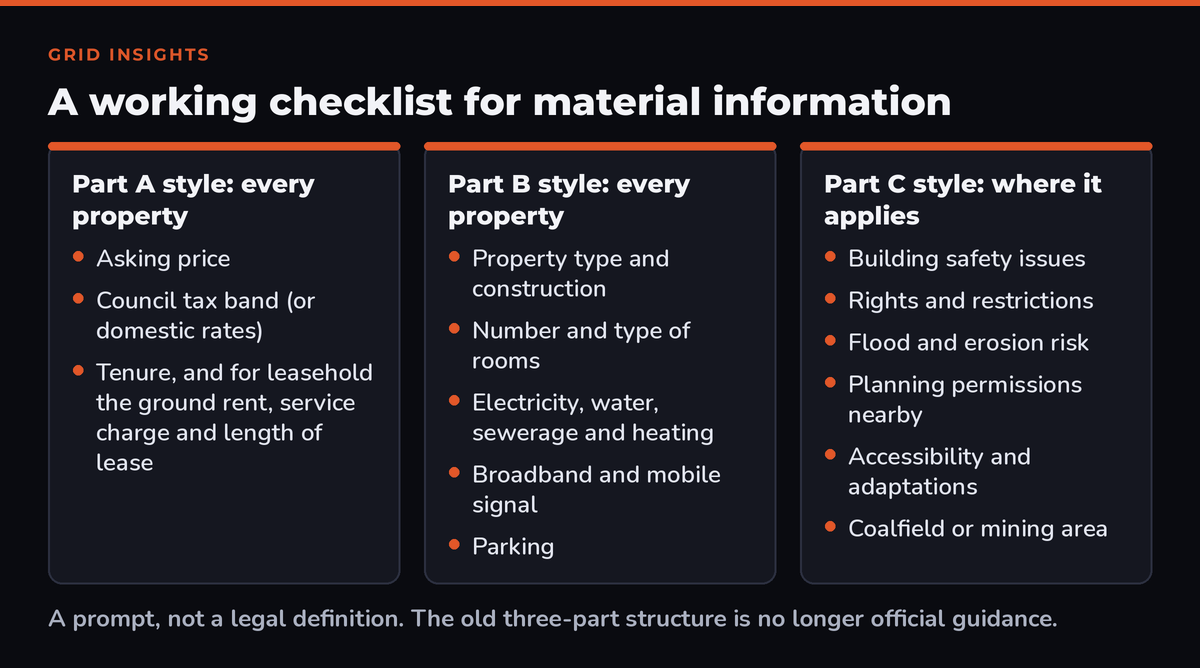
The old three-part structure is no longer official guidance, but industry guides still use it as a practical checklist, and I think it is a reasonable one. Treat it as a prompt, not a legal definition.
Part A style: every property
- Asking price
- Council tax band (or domestic rates)
- Tenure; for leasehold, the ground rent, service charge and length of lease
Part B style: every property
- Property type and construction
- Number and type of rooms
- Electricity, water, sewerage and heating
- Broadband and mobile signal
- Parking
Part C style: where it applies
- Building safety issues
- Rights and restrictions, such as covenants, rights of way or listed status
- Flood and erosion risk
- Planning permissions and proposals nearby
- Accessibility and adaptations
- Coalfield or mining area
Part C is where most gaps appear, because the seller often does not know the answers. Several of these items are what property searches report on.
Where the process breaks
The legal test is rarely what causes the gaps. The process is. Information is collected on a valuation visit in a notebook, typed up later, then partly forgotten. The vendor says "I think it is freehold", and "I think" becomes "freehold" in the listing. Nobody checks. Nobody knows who last checked.
A workflow that fixes the process
- Capture at the valuation. A structured form completed on a tablet or phone while you are at the property, with a field for every item above. Not free text.
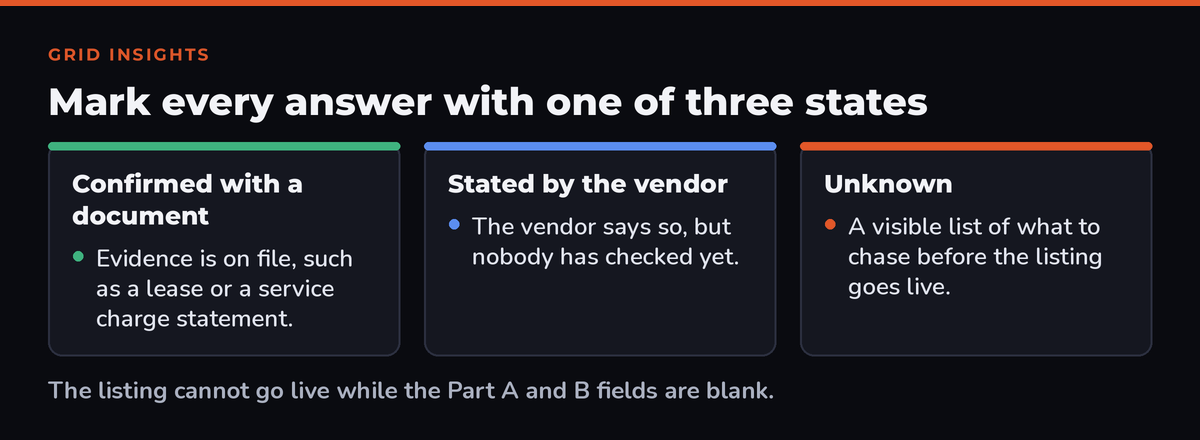
- Mark each answer as one of three states: confirmed with a document, stated by the vendor, or unknown. The "unknown" state matters. It gives you a visible list of what to chase.
- Chase automatically. The vendor gets a short message listing the documents that would confirm the unknowns, such as a lease, service charge statements or a broadband speed check.
- Block publication until the minimum is complete. The listing cannot go live while the Part A and B fields are blank.
- Generate the listing from the data. The listing is built from the fields, so the council tax band shown is the one that was recorded.
- Keep a trail. A dated record of what was asked, what was answered and what was confirmed.
- Review on change. If the price drops, or a buyer raises a question, the record is updated and the listing refreshed.
A word on AI
AI can help with the drafting, such as turning a set of confirmed fields into a readable description. I would not use it to fill a gap. A language model will happily write fluent text about a property whose tenure nobody has checked. The facts must come from the record, and a person must check them.
Checklist: before a listing goes live
- Price, council tax band and tenure are recorded and confirmed.
- For leasehold, ground rent, service charge and lease length are documented.
- Property type, rooms, utilities, broadband and parking are recorded.
- Known issues, such as flood risk or restrictions, are recorded or marked as unknown and being chased.
- Every answer is marked confirmed, vendor stated or unknown.
- The listing text matches the record.
- A named person has checked the listing.
- The record is dated and stored with the instruction.
Where GRID fits
The GRID services page sets out CRM pipelines mapped to a sales process, lead tracking and workflows. A structured valuation-to-listing process is the kind of operations tool that sits on top of that. The decisions about what is material remain yours.
Frequently asked questions
Is there an official list of material information for property listings?
Not at the moment. The government's consultation says the DMCC Act does not include a prescribed list specific to residential property, and that no sector-specific guidance had been produced since the Act took effect.
Do I have to put material information in the listing itself?
The consultation says estate agents should consider including all the information a likely buyer needs in the listing, and that material information must be given clearly and in good time. Take advice on your own approach.
Are sales packs compulsory yet?
As of late November 2026, industry guides say they are not. The government has said it intends to legislate when parliamentary time allows.
---
End of article
Sources
- GOV.UK (MHCLG), Material information in property listings (updated 19 June 2026), accessed 26 November 2026.
- CMA via GOV.UK, Unfair commercial practices (DMCC Act provisions apply from 6 April 2025), accessed 26 November 2026.
- National Trading Standards, Material information, accessed 26 November 2026.
- Casera, Material Information for Estate Agents: The Rules in 2026 (industry guide; source for the withdrawal date, the Part A to C checklist and the 2026 roadmap summary), accessed 26 November 2026.
- Light and Polish, UK Floor Plans and Room Sizes: Rules for Estate Agents (industry guide; checked National Trading Standards page on 21 November 2026), accessed 26 November 2026.
- GRID Marketing, Services, accessed 26 November 2026.
Next step
General information, not legal advice.
You can also contact us if you would rather send a message.