Local SEO for UK Service Businesses: A Practical Guide
Ask most owners of small and medium-sized businesses what local SEO is and you will hear one of two answers. Either it is a mysterious thing they paid someone for once, or it is something that stopped working when AI answers arrived. Neither is quite right, and neither helps you get found.
This guide is for UK service businesses that want to appear when someone nearby searches for what they do. It covers the fundamentals that still matter, what Google actually says about its AI features, and a checklist you can work through in an afternoon. I will not promise rankings. Nobody honestly can.
What Google says about AI answers
Google's guidance for site owners on AI Overviews and AI Mode is unusually direct. It says the best practices for SEO remain relevant for AI features, and that there are no additional requirements to appear in AI Overviews or AI Mode, nor other special optimisations necessary. To be shown as a supporting link, a page must be indexed and eligible to be shown in Search with a snippet. There are no additional technical requirements.
It also says you do not need to create new machine-readable files, AI text files or markup to appear, and that there is no special schema.org structured data you need to add. And it notes that meeting every requirement does not guarantee Google will crawl, index or serve a page.
That is worth remembering the next time someone offers to sell you an "AI visibility" package. The fundamentals are the same ones that were always there.
The fundamentals Google lists
From the same guidance, the practices that remain worthwhile include:
- allowing crawling in robots.txt and by any CDN or hosting;
- making content easy to find through internal links;
- providing a great page experience;
- making sure important content is available in text;
- supporting text with good images and video;
- making sure structured data matches the visible text on the page; and
- checking that your Business Profile information is up to date.
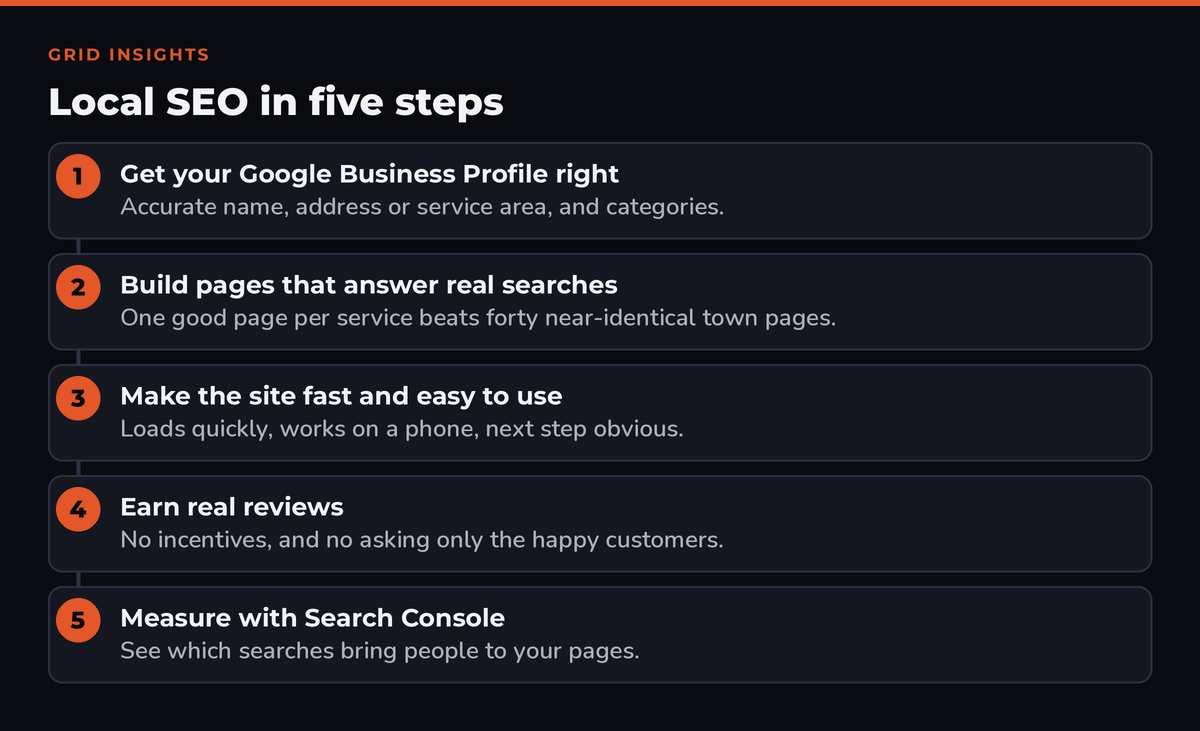
Step one: get your Google Business Profile right
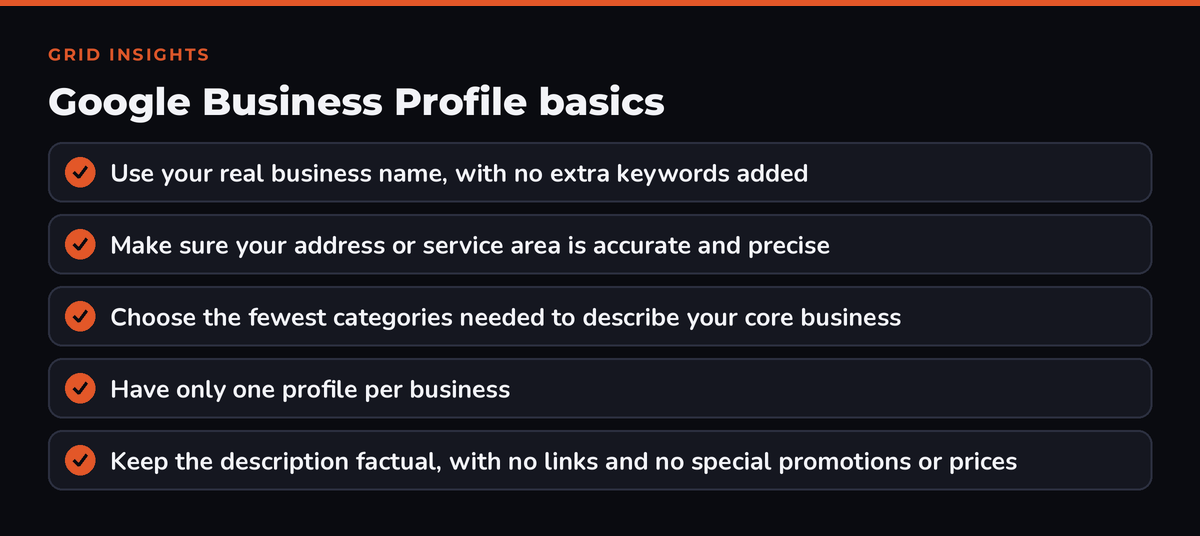
For a local service business, your Business Profile is often the first thing a customer sees. Google's guidelines are specific:
- Represent your business as it is consistently recognised in the real world, across signage, stationery and branding. Your profile name should be your real name, without extra keywords added.
- Make sure your address or service area is accurate and precise.
- Choose the fewest categories needed to describe your core business.
- Have only one profile per business.
- Keep the description factual. It should not contain links, and should not focus on special promotions or prices.
Adding "Cheap Plumber Bournemouth 24 Hour" to a business name may feel like a trick that works. Google's guidelines say your name should reflect the real-world name, and profiles that break the rules risk changes or removal.
Step two: build pages that answer real searches
Think about the searches your customers make, such as "fence repair near me" or "personal trainer in Poole", and make sure there is a useful page for each service you want to be found for. In my view, one good page per service beats forty near-identical town pages. Each page should say what you do, who it is for, where you work, roughly how it works, and how to book.
Write for the reader. Use plain headings that match how people ask. A short FAQ on the page, with honest answers, helps both visitors and search engines understand what the page covers.
Step three: make the site fast and easy to use
Google lists page experience among the fundamentals. In practice that means a site that loads quickly, works on a phone, and makes the next step obvious. Our post on what a high-converting website needs goes through the details, including Google's Core Web Vitals thresholds.
Step four: earn real reviews
Reviews are part of how local businesses are judged. Earn them honestly. Google's policy does not allow offering incentives for reviews or selectively asking only happy customers, and UK law now bans fake reviews and hidden incentives. Our post on how landscapers can get Google reviews sets out a request process that applies to any trade.
Step five: measure with Search Console
Verify your site in Google Search Console. It shows which searches bring people to your pages, which pages are indexed, and any technical problems. Google says sites appearing in AI features are included in the overall search traffic reported in Search Console, in the Performance report under "Web". You do not need a separate tool to get started.
What I would not do
- Buy a package that promises page one. Google says indexing and serving is never guaranteed.
- Stuff keywords into your business name, headings or description.
- Publish dozens of thin town pages.
- Write for machines. Write for the person who is about to ring you.
- Ignore the follow-up. Ranking brings an enquiry. What you do next decides whether it becomes a job.
Checklist: local SEO in an afternoon
- Business Profile name, address or service area, hours and categories are accurate.
- Only one profile exists for the business.
- The description is factual, with no links or promotions.
- Each core service has its own useful page.
- Headings match how customers ask.
- Pages load quickly and work on a phone.
- Structured data, if used, matches what is visible on the page.
- The site is verified in Search Console and you check it monthly.
- Reviews are requested from every customer, with no incentives.
- Enquiries get a reply and a booking link quickly.
Where GRID fits
The GRID services page sets out website and automation builds that can include an on-page SEO set-up: schema markup, page hierarchy and optimised asset speed, plus ongoing checks that the site is indexed cleanly. That covers the technical foundations. The content and the customer experience still have to be good.
Frequently asked questions
Do I need special markup to appear in Google's AI Overviews?
No. Google's guidance says there are no additional requirements, no special schema.org structured data and no AI text files needed. Standard SEO best practice applies.
How long does local SEO take?
It varies, and anyone who gives you a fixed timeline is guessing. Google says that meeting the requirements does not guarantee a page will be crawled, indexed or served.
Can I put keywords in my Google Business Profile name?
Google's guidelines say your name should reflect your real-world business name, as used on your signage and website. Adding extra keywords risks your profile being changed or removed.
End of article
Sources
- Google Search Central, AI features and your website (last updated 10 December 2025), accessed 26 November 2026.
- Google Business Profile Help, Guidelines for representing your business on Google, accessed 26 November 2026.
- Google, Web Vitals, accessed 26 November 2026.
- Google, Maps User Generated Content Policy: Prohibited and restricted content, accessed 26 November 2026.
- GRID Marketing, Services, accessed 26 November 2026.
Next step
You can also contact us if you would rather send a message.