
How Landscapers Can Get Google Reviews the Right Way
You finish a patio on a Friday afternoon. The customer walks round it twice, says it is better than they hoped, and tells you they will "definitely leave a Google review". You pack the van. The review never arrives.
I hear a version of this from almost every trade. The work is good, the customer is happy, and the review does not happen, because nobody has made it easy and nobody has asked twice. The tempting shortcuts are discounts, only asking the happy ones, or writing a few yourself. Those are exactly the things that now get businesses into trouble.
Why it matters that you get this right
Customers look. Trading Standards advice aimed at householders hiring a landscaper or gardener, for instance from Powys County Council, tells people to research the trader online, including checking for negative reviews, and to ask for references. Your reviews are part of how a stranger decides whether you are who you say you are.
The rules also tightened. From 6 April 2025, the Digital Markets, Competition and Consumers Act 2024 made it automatically unfair to commission or submit fake reviews, or to hide the fact that a review was incentivised. The Competition and Markets Authority (CMA) published guidance on this in April 2025, and businesses that publish reviews are expected to take reasonable and proportionate steps to prevent and remove them.
Google has its own rules, and they are blunt. Its Maps content policy does not allow merchants to:
- offer incentives such as payment, discounts or free goods or services in exchange for a review, or for removing a negative one;
- discourage or prohibit negative reviews, or selectively solicit positive ones;
- pressure customers to leave reviews while on the premises, or ask for specific content, such as naming a staff member.
What Google does allow is soliciting or encouraging reviews that represent a genuine experience, without offering incentives or trying to influence the rating or content.
The thing most people do wrong: gating
"Review gating" means filtering who gets the public link. You send a private feedback form first, and only the customers who score you highly are then shown the Google button. It looks efficient and it feels harmless. Under Google's policy, selectively soliciting positive reviews is not allowed, and I would not build it into any process.
The simpler approach is also the safer one. Ask everyone.
A request process that holds up
When I sketch this out for a small landscaping business, I keep it plain:
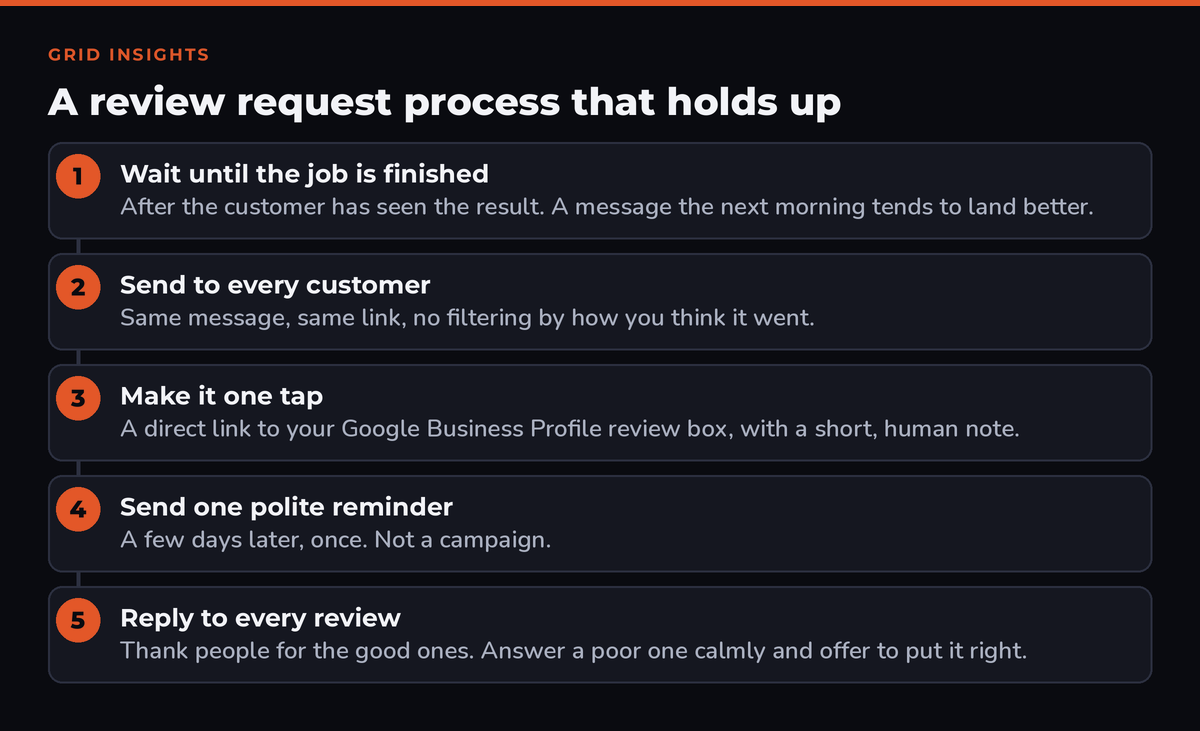
- Trigger it at the right moment. After the job is finished and the customer has seen the result, not when the quote is accepted and not while you are still on the drive packing up. A message the next morning tends to land better than a request on the doorstep.
- Send to every customer. Same message, same link, no filtering by how you think it went.
- Make it one tap. A direct link to your Google Business Profile review box, in a text or email, with a short, human note. The fewer steps, the more replies.
- Send one polite reminder. A few days later, once. Not a campaign.
- Reply to every review. Thank people for the good ones. For a poor one, reply calmly, factually and briefly, offer to put it right, and take the detail offline. Future customers read your replies as much as the reviews.
- Do not ask for specific words. Do not suggest they mention their town or the service, and do not ask them to name your team. It may feel like harmless SEO. Google's policy says not to.
An illustrative message:
"Hi [name], thanks for choosing us for your new patio. If you have a minute, we'd really value an honest review of how it went. Here's the link: [link]. Either way, thank you, and do get in touch if anything needs another look."
Checklist: reviews you can stand behind
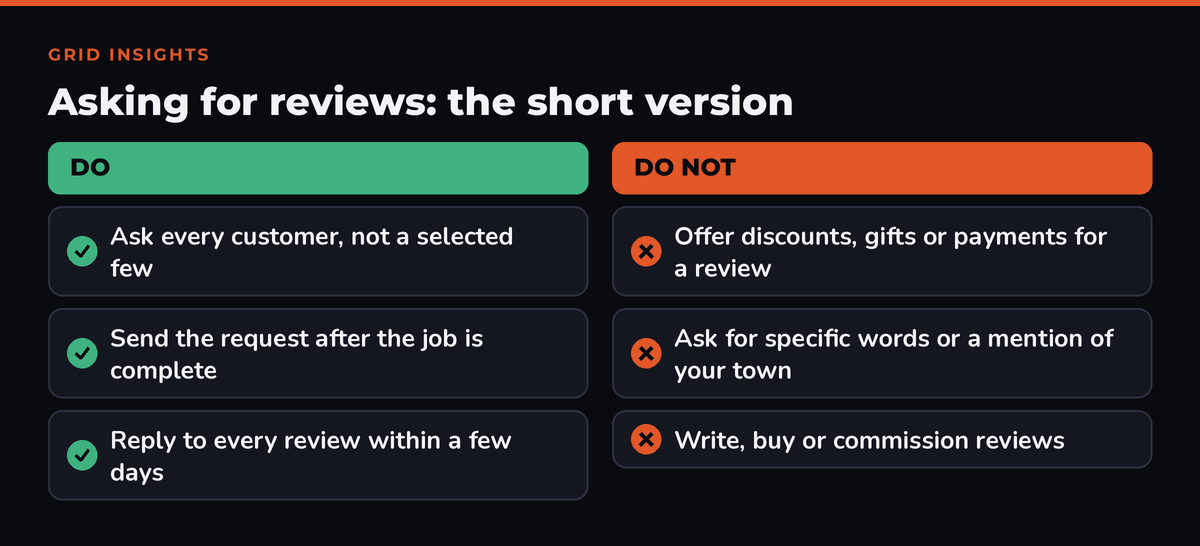
- I ask every customer, not a selected few.
- I never offer discounts, gifts or payments for a review, or for removing one.
- I never write, buy or commission reviews, and I do not ask friends or family to post them.
- I do not ask customers to review while they are standing on site, or to include particular wording.
- The request goes out after the job is complete.
- There is one reminder, not a chase.
- Every review gets a reply within a few days.
- Negative reviews are answered calmly, with an offer to resolve it.
- I keep a record of when requests were sent.
- If I display reviews on my website, I show a fair picture and do not hide the less flattering ones.
Where automation helps
This is a task that fails for the plainest reason: someone is busy. An automated request fires when you mark a job complete, so it does not depend on remembering. The GRID services page sets out automatic review-request flows that can link to a Google Reviews or Trustpilot profile. For a landscaper I would set the trigger at job completion, not at the point a deal is won, and I would send to every customer rather than a filtered group.
Software will not fix a poor job or write an honest reply. It will make sure the ask happens, every time, in a way that stays within the rules.
Frequently asked questions
Can I offer a discount on the next job in return for a Google review?
No. Google's Maps policy prohibits merchants from offering incentives such as discounts or free goods or services in exchange for a review, and the DMCC Act bans hiding that a review was incentivised.
Can I ask customers to mention the town or the type of work in their review?
Google's policy says merchants should not request that specific content be included. Ask for an honest review and leave the wording to the customer.
What should I do about a review that is unfair?
Reply politely and factually, and offer to discuss it. If a review breaks Google's content policy, you can report it to Google. Do not offer anything in return for its removal.
---
End of article
Sources
- Competition and Markets Authority via GOV.UK, Fake reviews guidance (published 4 April 2025), accessed 26 November 2026.
- CMA via GOV.UK, Unfair commercial practices (DMCC Act provisions apply from 6 April 2025), accessed 26 November 2026.
- Google, Maps User Generated Content Policy: Prohibited and restricted content, accessed 26 November 2026.
- Trading Standards Wales (Powys), Rogue traders targeting Powys homes, accessed 26 November 2026.
- GRID Marketing, Services, accessed 26 November 2026.
Next step
General information, not legal advice.
You can also contact us if you would rather send a message.