Personal Trainer Cancellation Policy: A Fair UK Guide
There is a particular kind of silence that a personal trainer knows well. It is 6:45 on a Tuesday, the studio is set up, and the client who booked this slot has not arrived and has not messaged. You wait ten minutes, send a text, wait another ten. The hour is gone. You could not fill it, and without a personal trainer cancellation policy you can stand behind, charging for it means an awkward conversation.
Most trainers deal with this in one of two ways. They say nothing and absorb the cost, or they write a strict policy that they are nervous to enforce. Neither is a system. A personal trainer cancellation policy only works as part of a system: a reminder that makes turning up easy, terms that are fair enough to be defended, and a process that applies them the same way every time.
What the evidence says about reminders
I want to be straightforward about what we do and do not know. The best-known research on text reminders comes from healthcare, not fitness, so treat it as a useful indication rather than a promise.
A Cochrane review of trials on mobile phone text message reminders for healthcare appointments found moderate-quality evidence that reminders improved attendance compared with no reminders (risk ratio 1.14). Across the trials, attendance was 67.8% with no reminder and 78.6% with a text message reminder. Text messages worked about as well as phone call reminders and cost less per attendance. The authors also noted that the evidence was low to moderate in quality and that more research was needed.
That is not a claim that texts will cut your no-shows by a set amount. A medical appointment and a 6:45am training session are different things. What it does suggest is that a well-timed reminder is a sensible, cheap first step, and that forgetfulness is a real cause of missed appointments.
What UK law says about cancellation fees
Many trainers fear a late cancellation fee will be "illegal". It is not, but it needs to be fair.
The Consumer Rights Act 2015 includes a list of terms that may be regarded as unfair. Two are relevant here: a term that requires a consumer who decides not to go ahead to pay a disproportionately high sum in compensation, and a term requiring a consumer who fails to meet their obligations to pay a disproportionately high sum. "May be regarded as unfair" is not the same as "is unfair", but it tells you where to be careful.
The Competition and Markets Authority (CMA) put the principle plainly in a blog about holiday deposits. Businesses are entitled to ask for a fee when a customer cancels, to cover their losses, but the amount kept must be in proportion to what they actually lose. If a term is judged unfair by a court, it cannot be enforced against the customer even if they signed it. That blog is about holidays, and your business is different, but the proportionality idea is the same.
What does that mean for a trainer? A fee that reflects a genuine loss, and that is lower where you can refill the slot, is easier to defend than a flat penalty that bears no relation to what you lost. That is my reading, not legal advice. If you charge a lot, or sell large prepaid blocks, ask a solicitor or Trading Standards to look at your terms.
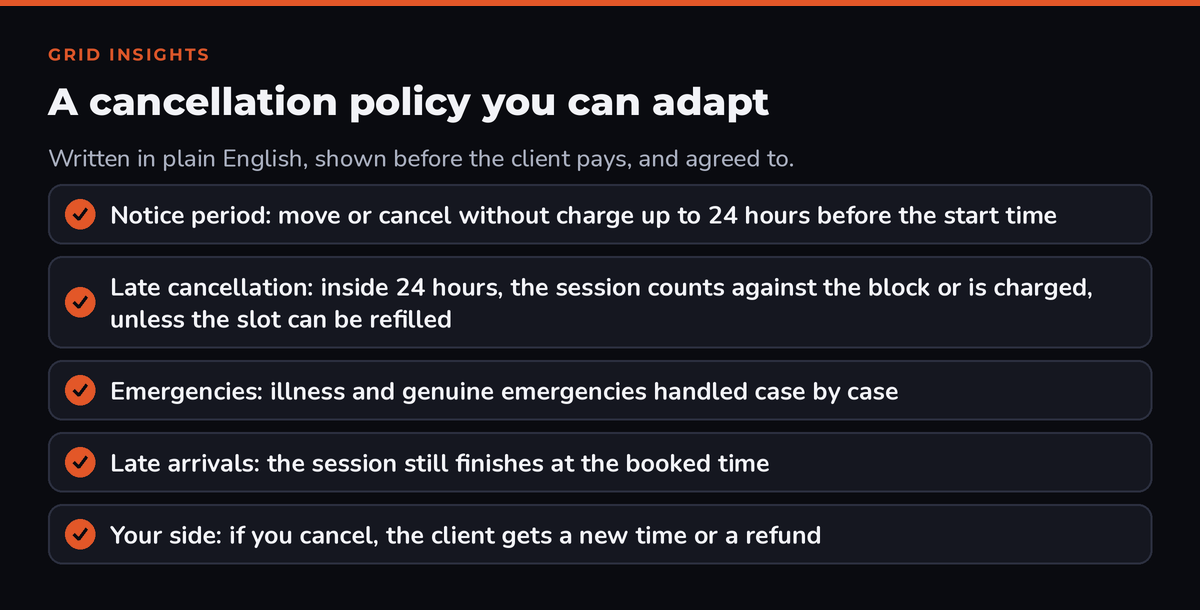
A policy you can adapt
This is an illustration, not a template to copy without thinking:
- Notice period. Sessions can be moved or cancelled without charge up to 24 hours before the start time.
- Late cancellation. Inside 24 hours, the session is counted against your block or charged, unless the slot can be refilled, in which case no charge is made.
- Emergencies. Illness and genuine emergencies are handled case by case, at your discretion.
- Late arrivals. The session still finishes at the booked time, so the client does not lose time without notice.
- Your side. If you cancel, the client is offered a new time or a refund. The rule works both ways.
Two points matter more than the exact numbers. The policy should be written in plain English, shown before the client pays, and agreed to, not buried in a PDF. And it should include the "refill" clause, because it keeps the policy tied to your real loss.
The reminder sequence
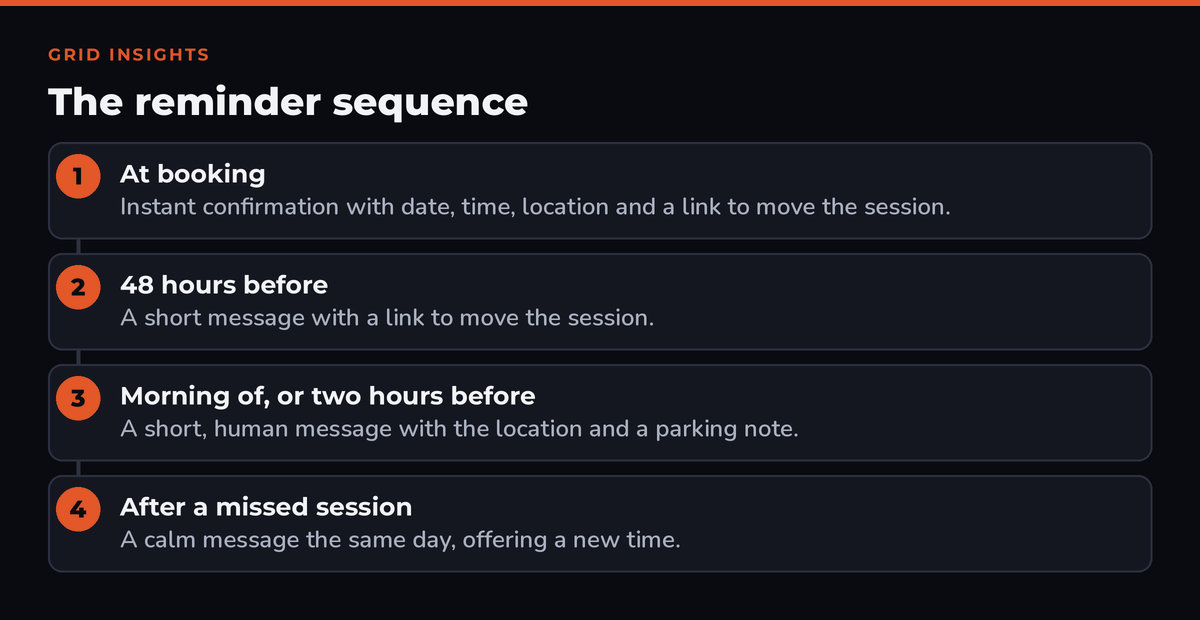
The reminders are where a booking system earns its keep. A sensible sequence, built around the client rather than around your convenience:
- At booking. Instant confirmation with date, time, location and a link to move the session.
- 48 hours before. A short message: "Tuesday 6:45am with [name]. Need to move it? Use this link."
- Morning of, or two hours before. A short, human message with the location and parking note.
- After a missed session. A calm message the same day, offering a new time and pointing to the policy, rather than a sharp email at midnight.
The aim is to make the right action the easy one. "Reply to this message" is easier than "ring me". A rebooking link is easier than either.
A note on the rules for these messages. The ICO says appointment reminders are service messages, not direct marketing. But if the same text includes promotional content, such as an offer on a new package, it becomes marketing and needs the right consent. Keep reminders to reminders.
Checklist: a no-show system
- My cancellation terms are written in plain English and shown before payment.
- The fee or session deduction reflects what I would genuinely lose, and I have thought about slots I can refill.
- The policy applies to me as well as to the client.
- Every booking gets an instant confirmation.
- Reminders go out automatically at set times, with an easy rebooking link.
- Reminders contain no promotional content.
- Missed sessions get a same-day, friendly follow-up.
- I apply the policy the same way for everyone, and record any exception.
- I review the numbers every month: how many cancellations, how many no-shows, how many refilled.
What I would not do
I would not use a deposit as a punishment. A small deposit that secures a slot can be reasonable, but the CMA's general view is that deposits should only be a small percentage of the total cost. I would not make the policy so rigid that you lose a good client over a genuine emergency. And I would not rely on a policy to do the job of a relationship. Clients who feel looked after turn up.
Where GRID fits
The GRID services page sets out booking calendars, multi-step countdown reminders, and the option to take a Stripe or PayPal deposit to lock a slot. I would treat those as building blocks. The decisions about what to charge and when are yours, and they should be made first.
This article is general information, not legal advice.
---
Frequently asked questions
Is a personal trainer cancellation fee legal in the UK?
A fee can be lawful if it is fair and in proportion to what you actually lose. The Consumer Rights Act 2015 lists terms that may be regarded as unfair, including a disproportionately high sum when a client cancels. This is general information, not legal advice. If you charge a lot, or sell large prepaid blocks, ask a solicitor or Trading Standards to look at your terms.
How much notice should a client give to cancel a session?
A common approach is 24 hours. In the illustration above, sessions can be moved or cancelled without charge up to 24 hours before the start time. Choose a period you can actually administer, show it before the client pays, and apply it the same way for everyone.
Are appointment reminder texts allowed without marketing consent?
The ICO treats appointment reminders as service messages, not direct marketing, provided they stay as reminders. If the same text includes a promotion, it becomes marketing and needs the right consent. Keep reminders to reminders.
Should I still charge if I can refill the cancelled slot?
In the policy illustration, no charge is made if the slot is refilled, because the fee should stay tied to a genuine loss. That refill clause is, in my view, what keeps the policy easier to defend and easier to explain to a client.
End of article
Sources
- Cochrane, Mobile phone messaging reminders for attendance at healthcare appointments (Gurol-Urganci et al., 2013), accessed 26 November 2026.
- legislation.gov.uk, Consumer Rights Act 2015, Schedule 2: consumer contract terms which may be regarded as unfair, accessed 26 November 2026.
- Competition and Markets Authority, Holiday deposits and cancellation fees: are you being treated fairly? (27 June 2019), accessed 26 November 2026.
- ICO, Marketing and data protection in detail (service messages versus direct marketing), accessed 26 November 2026.
- GRID Marketing, Services, accessed 26 November 2026.
Next step
General information, not legal advice.
You can also contact us if you would rather send a message.