
Cooling-Off Period for Landscapers: The 14-Day Rule
It is a bright Saturday in March. You have just walked a customer round the back garden and agreed a price for a new patio and raised beds. They are keen. "Can you start Monday?" they ask. You can. The diary is quiet, the weather is good, and nobody wants to talk about paperwork.
This is the moment the 14-day cooling-off period was written for, and it is one that landscapers regularly walk past. I am not a solicitor and this is general information, not legal advice. But the rule is clear enough on the official pages that it is worth setting out, and then building into your process so it does not depend on remembering.
Which jobs it covers
If you agree a job with a consumer at their home, their workplace or another person's home, GOV.UK describes it as selling door to door, and you have to give certain information and a right to cancel. The rules in the Consumer Contracts Regulations 2013 cover both "off-premises" contracts like this and "distance" contracts agreed by phone, email or online. So the quote you walked round on Saturday and the one the customer accepts by email on Wednesday both fall in scope.
There are exceptions. GOV.UK lists goods and services worth £42 or less, and the construction of new buildings (but not extensions). Citizens Advice also says there is no automatic cooling-off period where you are invited in for urgent repairs or maintenance at the customer's request. I would be cautious about stretching that last one: "the customer wanted it done quickly" is not the same as "urgent repair".
What you have to give them before they are bound
GOV.UK sets out the information to provide, in a form the customer can keep (paper, email, or something they can save). The list for a typical landscaping job includes:
- your business name, contact details and address;
- a description of the work;
- the total price, or how it will be calculated;
- how they can pay, and the amount and conditions of any deposit;
- how they can cancel, when they lose the right, and a standard cancellation form;
- whether they would still have to pay reasonable costs for work done if they cancel;
- your complaints policy, if you have one.
The 14 days, and what happens if you skip it
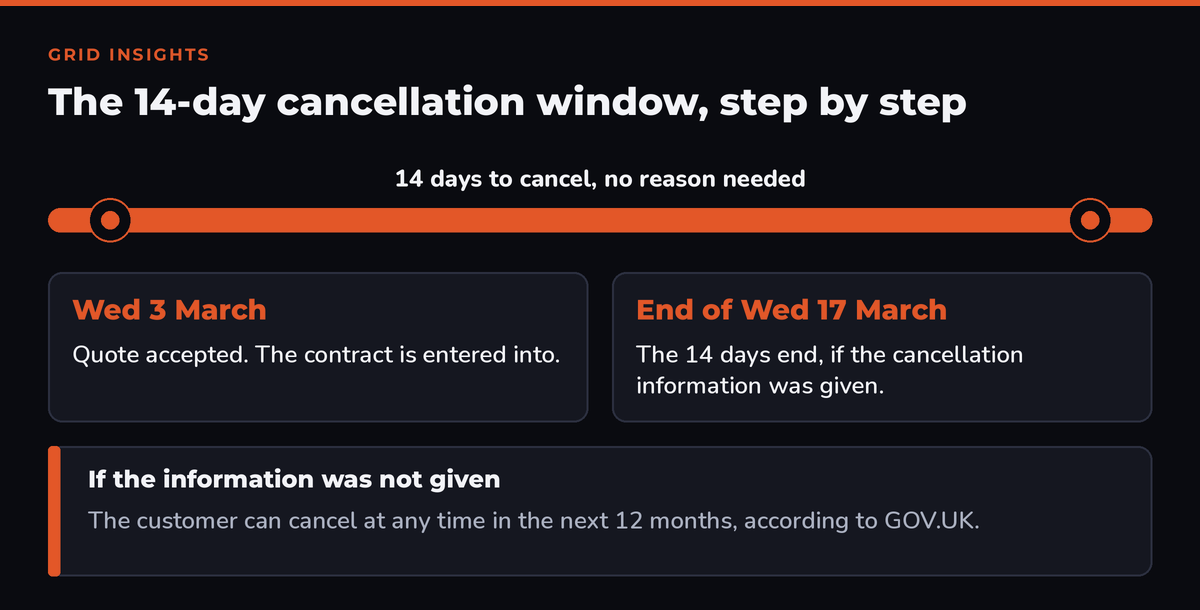
For a service contract, the cancellation period runs for 14 days after the day on which the contract is entered into. The customer does not need to give a reason.
If you do not tell the customer about their right to cancel, GOV.UK says they can cancel at any time in the next 12 months, and that you could face an unlimited fine and up to two years in prison. That is the part that surprises most small traders. The consequence of leaving out a piece of paper is not a small one.
An illustration
The customer accepts your quote by email on Wednesday 3 March. The 14 days run to the end of Wednesday 17 March. If you did not give them the cancellation information, the period can be stretched far beyond that.
Starting work early: the trap
Here is where Saturday's "Can you start Monday?" matters. Regulation 36 says you must not start the service before the cancellation period ends unless the customer has made an express request and, for an off-premises contract, made it on a durable medium (an email or a signed form works, a nod in the garden does not).
If they ask for an early start and later cancel, they must pay an amount in proportion to what you have supplied up to the point you were told. But if you did not give them the required information about the right to cancel and about paying for work done, or the start was not in response to their request, they bear no cost for any work done in the period. In plain terms: starting early without the paperwork can leave you doing the job for nothing.
Council Trading Standards guidance, such as Midlothian's, advises getting the customer's written consent to an early start. That is sensible. Make it a separate, specific tick, not a line buried in your terms.
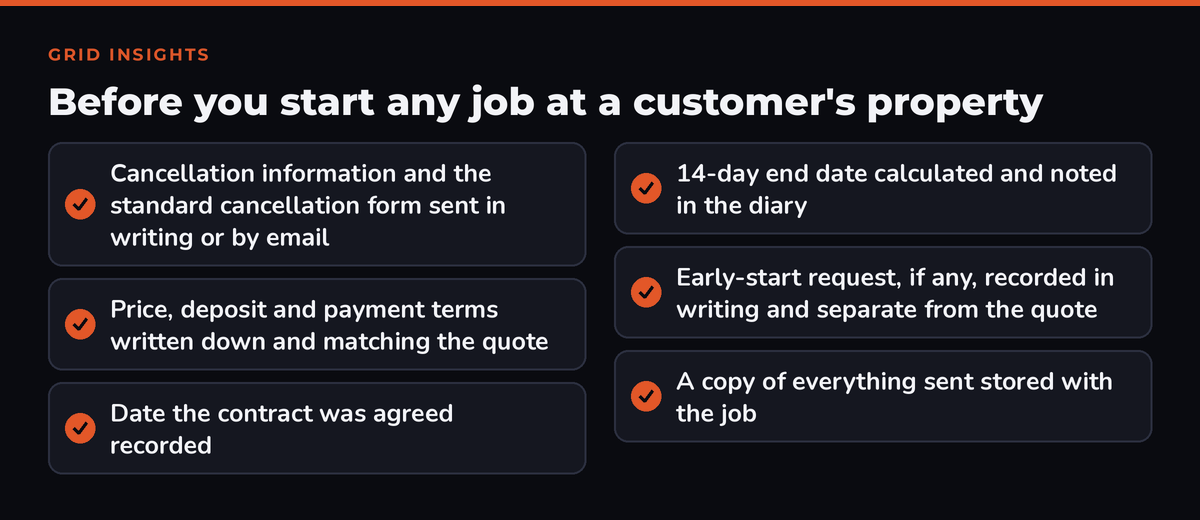
Checklist: before you start any job at a customer's property
- The customer has received your cancellation information and the standard cancellation form in writing or by email.
- The price, deposit and payment terms are written down and match the quote.
- The date the contract was agreed is recorded.
- The 14-day end date is calculated and noted in the diary.
- If the customer wants an early start, their express request is recorded in writing, separately from the quote.
- The early-start request says that they may have to pay for work already done if they cancel.
- Materials that cannot be returned are not ordered before the end of the period without considering the risk.
- Deposits are held in line with your terms and recorded.
- A copy of everything sent is stored with the job.
Where automation helps
This is a good example of a task that is easy to forget and easy to automate. When I think about how I would build it, the quote acceptance step does the work. The customer clicks to accept; they automatically receive the cancellation information and form; the acceptance time is stamped; a separate unticked box captures an early-start request if they want one; and the 14-day end date drops into your calendar.
On the GRID services page you will see CRM pipelines, booking engines and automated workflows listed. This is the type of problem they can be pointed at. The legal wording is yours to take from official sources, such as the Trading Standards model documents. The software only makes sure it is sent every time.
What I would not do
I would not treat the cooling-off period as an obstacle to be minimised. Customers who know exactly where they stand tend to trust a business more, and the cost to you is a few days' wait for a diary slot. If anything about your contracts is unusual, such as large deposits or bespoke materials, ask a solicitor or your local Trading Standards service before you rely on any rule of thumb.
Frequently asked questions
Do I need to give a cancellation notice if the customer visits my yard instead of me visiting them?
If the contract is made at your business premises, the off-premises rules do not apply in the same way. Citizens Advice explains that a cooling-off right depends on where the arrangement was made. If the customer then confirms by phone or email, distance rules may apply, so check your process.
Does the £42 threshold apply to every job?
GOV.UK says the door-to-door rules do not apply to goods and services worth £42 or less. Most landscaping jobs will be far above that.
Can I take a deposit before the 14 days are up?
You can set out deposit terms, and GOV.UK says you must state the amount and conditions. If the customer cancels within the period, the refund rules apply. Take advice on how you handle deposits.
---
End of article
Sources
- GOV.UK, Door to door sales, accessed 26 November 2026.
- legislation.gov.uk, Consumer Contracts (Information, Cancellation and Additional Charges) Regulations 2013, regulations 29, 30 and 36, accessed 26 November 2026.
- Citizens Advice, Cancelling building or decorating work, accessed 26 November 2026.
- Midlothian Council Trading Standards, Cancellation rights: home contracts, accessed 26 November 2026.
- GRID Marketing, Services, accessed 26 November 2026.
Next step
General information, not legal advice. Check your own contracts with a qualified adviser or Trading Standards.
You can also contact us if you would rather send a message.